
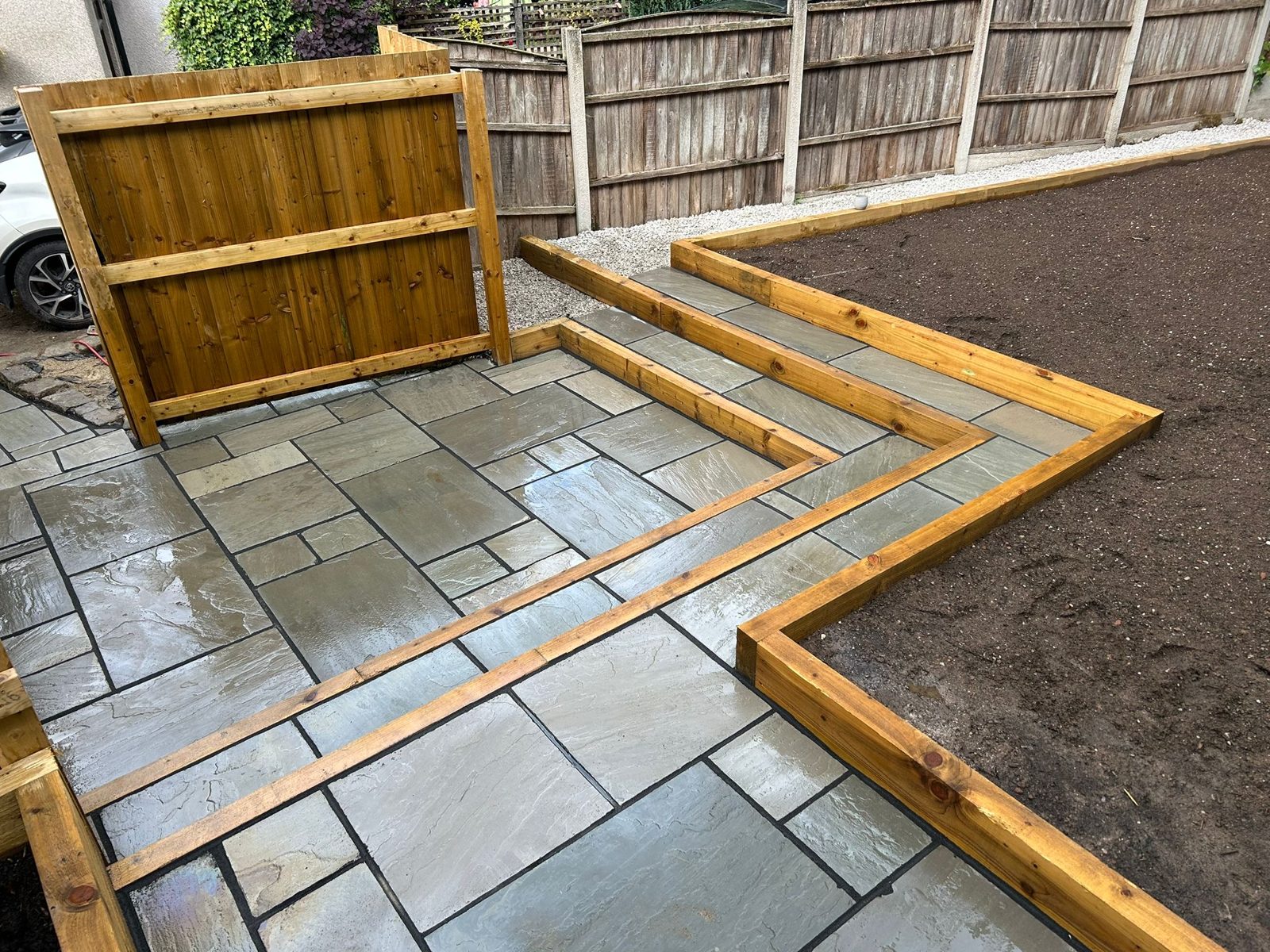
Patios & Paving in Manchester
Patios, paths and paved seating areas across Manchester — dug out properly, laid on a sub-base, with the falls set before the first flag goes down. Free no-obligation quotes.
Get a Fast Response
Tell us a little about your garden and we'll come straight back to you on WhatsApp or by email.
One City, and Several Very Different Things to Pave
Manchester sits about eleven miles south-east of Bolton, with Salford in between — the two boroughs do not actually touch. The run down is the A666 and the A6, or the M60 round the outside, depending on which side of the city the garden is on.
Paving is the service where the address changes the job more than the brief does. Much of the inner city — Chorlton, Withington, Didsbury, Levenshulme — is Victorian and Edwardian terraces and villas, where the paving is small, enclosed and hard to reach.
Out at Wythenshawe the interwar semis sit on noticeably bigger plots, so the same patio becomes a question of proportion rather than access. In the centre it is largely apartments, where a paved area is a balcony or a shared yard rather than a garden.
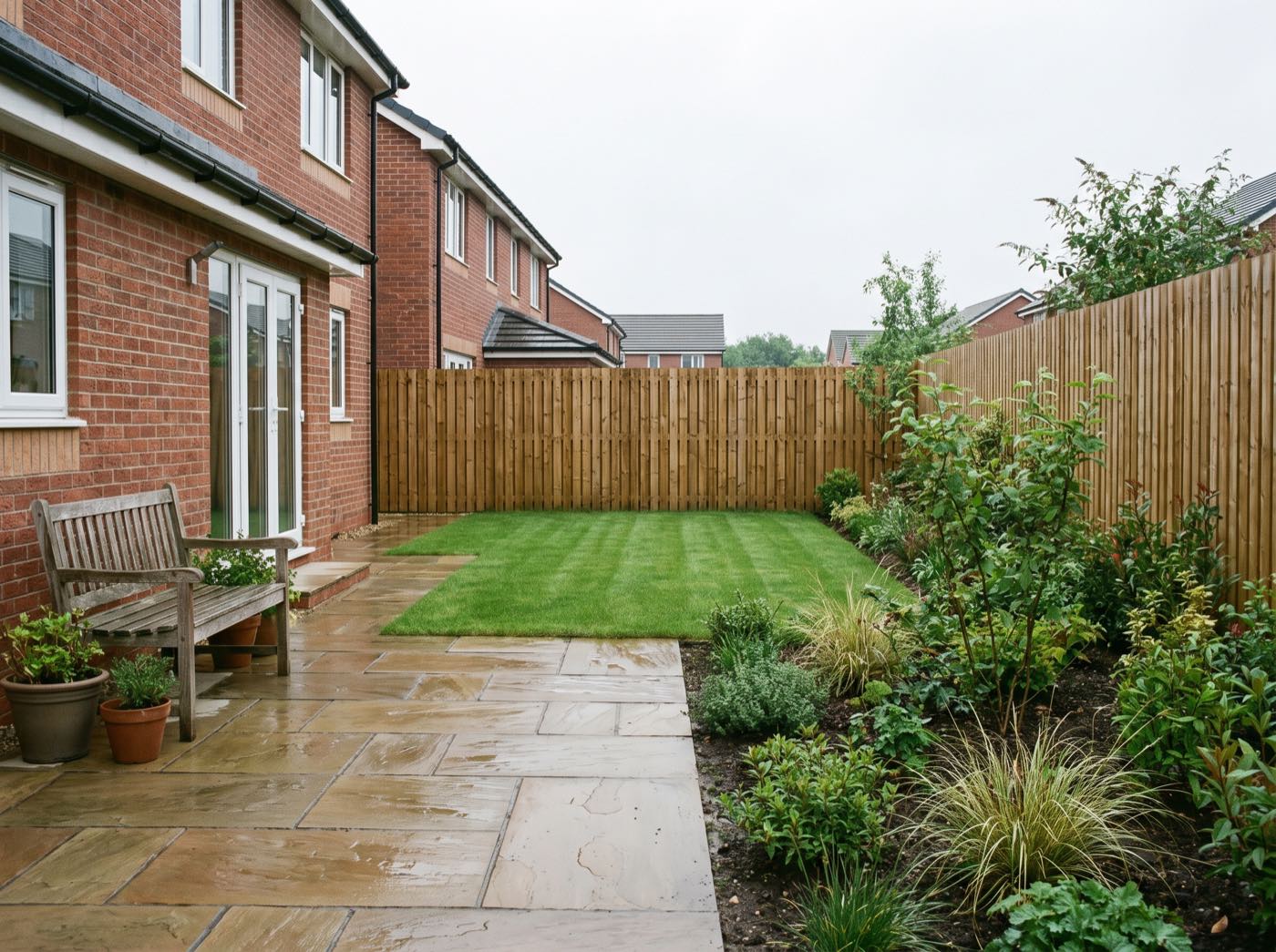
What Goes Under a Patio Decides How Long It Lasts
A patio is judged on the stone, and the stone is the part that almost never fails. Flags rock, sink and open at the joints because of what was or was not done underneath before they were laid.
Digging out to the right depth
Paving needs a hole before it needs a surface. Soft ground, old turf and buried rubble come out first, which is why a patio is a bigger dig than most people expect.
A compacted sub-base
Stone laid in layers and compacted is what actually carries the patio. Bedding flags straight onto sand or soil is the single most common reason an old one has gone wavy.
Falls set away from the house
A patio is never laid dead level. It is given a slight fall so rain leaves it, and that fall always runs away from the building rather than towards the back door.
Edges that hold the paving in
Where the paving meets a lawn, a border or a step, something has to restrain it. Unrestrained edges creep outwards and the joints open behind them.
Getting the stone in and the spoil out
In the terraced streets there is often no vehicle access to the back, so the dug-out ground leaves by barrow and the paving arrives the same way.
That changes the labour rather than the materials, which is why where the load drops and where a skip can legally stand are site-visit questions.
Where the Water Goes Once a Garden Is Paved
Every square metre of paving is a square metre that used to soak up rain and now does not.
In a small city garden that is a real change, and it is the part of the job most likely to cause trouble later if it is skipped at the planning stage.
The water has to be given somewhere sensible to go: a fall to a border that can take it, a drainage channel across the bottom of the paving, a permeable build-up that lets rain through the joints, or a soakaway.
Which one is right is a site decision rather than a catalogue one.
Two related things get settled at the same time — the paving finishing below the damp-proof course rather than bridging it, and any gully or inspection cover staying reachable.
Front gardens are a separate question.
Paving one over for parking can bring planning rules into it, and how the surface drains is usually the deciding factor. Where a front is close to that line, the answer comes from Manchester City Council's planning team rather than from us.
What our patios & paving work in Manchester includes
- Porcelain and Indian stone patios
- Block paving and natural stone
- Proper sub-base and drainage falls
- Seating, dining and access areas
- No sinking, pooling or movement
- Clean, precise finishing
How We Work in Manchester
Initial Enquiry
You get in touch by phone, WhatsApp or the website.
Site Visit
We visit your Manchester property, assess the space, and discuss your ideas.
Recommendations
We suggest the best approach for your budget and requirements.
Detailed Quote
You receive a clear breakdown of the work involved.
Installation
The work is carried out with attention to detail from start to finish.
Completion
You’re left with a fully transformed outdoor space.
Trusted Across Greater Manchester
Our Other Services in Manchester
Landscaping in Manchester
Complete garden landscaping — designed, built and finished to a high standard, with …
Learn moreGarden Renovations in Manchester
Full garden transformations for outdoor spaces that are outdated, difficult to use, or sim…
Learn moreDecking in Manchester
Bespoke timber and composite decking — clean, usable outdoor areas built on proper f…
Learn moreFencing in Manchester
Strong, clean, professionally installed fencing for privacy, security and structure &mdash…
Learn moreArtificial Grass in Manchester
Low-maintenance artificial grass that stays clean, green and usable all year — insta…
Learn morePaving Around Manchester
Manchester's own boundaries run to Salford and Trafford in the west, Stockport to the south, Tameside to the east and Oldham and Bury to the north-east.
Our patios and paving in Salford page covers the borough sitting between the city and Bolton, and the main patios and paving page sets out how the build-up works whichever town the garden is in.
Patios and Paving in Manchester – Your Questions
Our Victorian terrace has no vehicle access to the back. How does a tonne of paving get there?
By barrow, through the house or along the alley, and the same route carries the dug-out ground back out.
It is how most inner-Manchester patios get built — but it is slower than a job a van can back up to, so it belongs in the quote rather than being discovered on day one.
The flags in our back garden are lifting and rocking. Can they be relaid or does it all have to come up?
It depends on why they are moving. If the base is sound and a few flags have dropped, relaying that area can be enough.
If they were bedded on sand or straight onto soil, relaying them on the same ground buys a season or two. That is judged by lifting one and looking underneath.
We want to pave the front garden for parking. Is there anything to check before we start?
Yes. Hard-surfacing a front garden can bring planning rules into play, and how the surface handles rainwater is usually what decides it.
A dropped kerb is a separate permission again, handled by the council's highways side. Manchester City Council is the right place to confirm both before any stone is ordered.
Our Wythenshawe plot is much bigger than a city-centre garden. Does a patio need to be bigger to match?
Not necessarily bigger, but sited differently. On a large interwar plot a patio pushed against the back wall can look marooned.
It is often better placed where the sun actually falls, with a path linking it back to the house.
Get a Free Patios & Paving Quote in Manchester
Thinking about patios and paving for your Manchester garden? Get in touch today for a free, no-obligation quote and honest advice.