
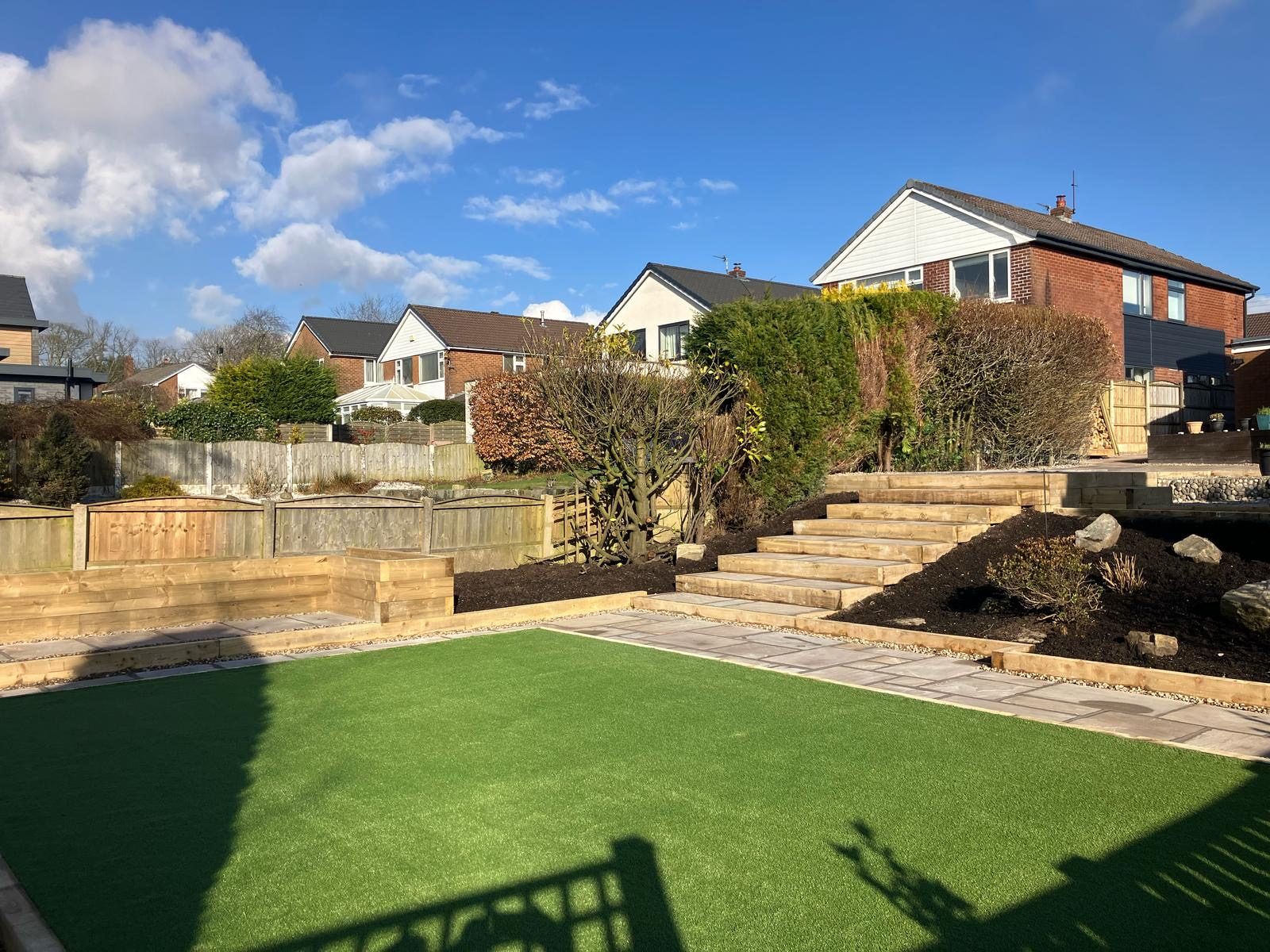
Garden Renovations in Wigan
Full garden transformations across Wigan — from tight terraced plots near the town centre to the bigger gardens out towards Standish and Aspull, reworked from the ground up.
Get a Fast Response
Tell us a little about your garden and we'll come straight back to you on WhatsApp or by email.
Getting a Renovation Into a Wigan Garden
Wigan sits west of Bolton, with the A58 running between the two through Westhoughton and Hindley and the M6 passing down the western side of the borough.
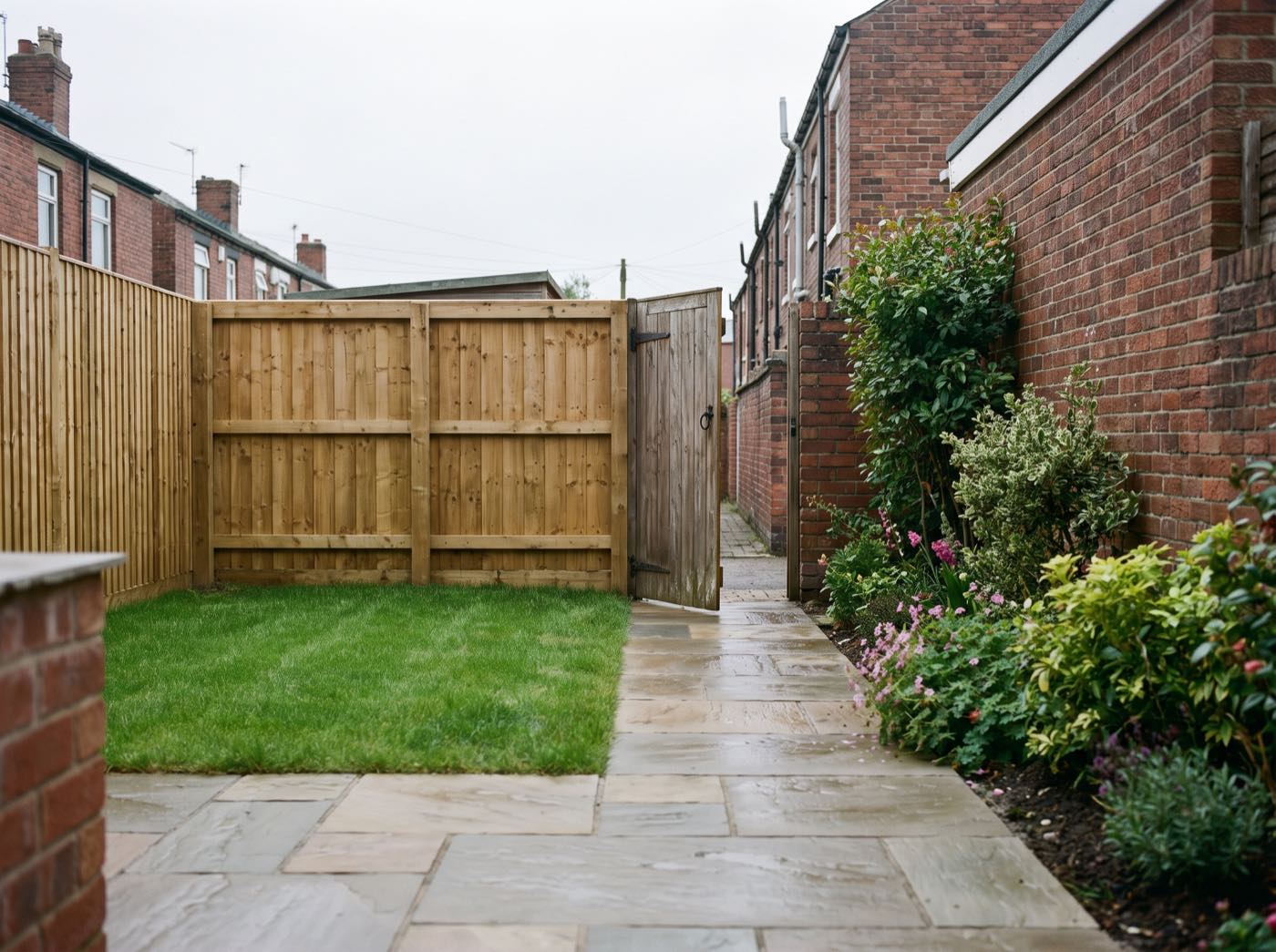
Close to the town centre, much of the housing is long terraced streets from the mill and pit years, and a lot of those back gardens are reached from a rear entry rather than a side gate.
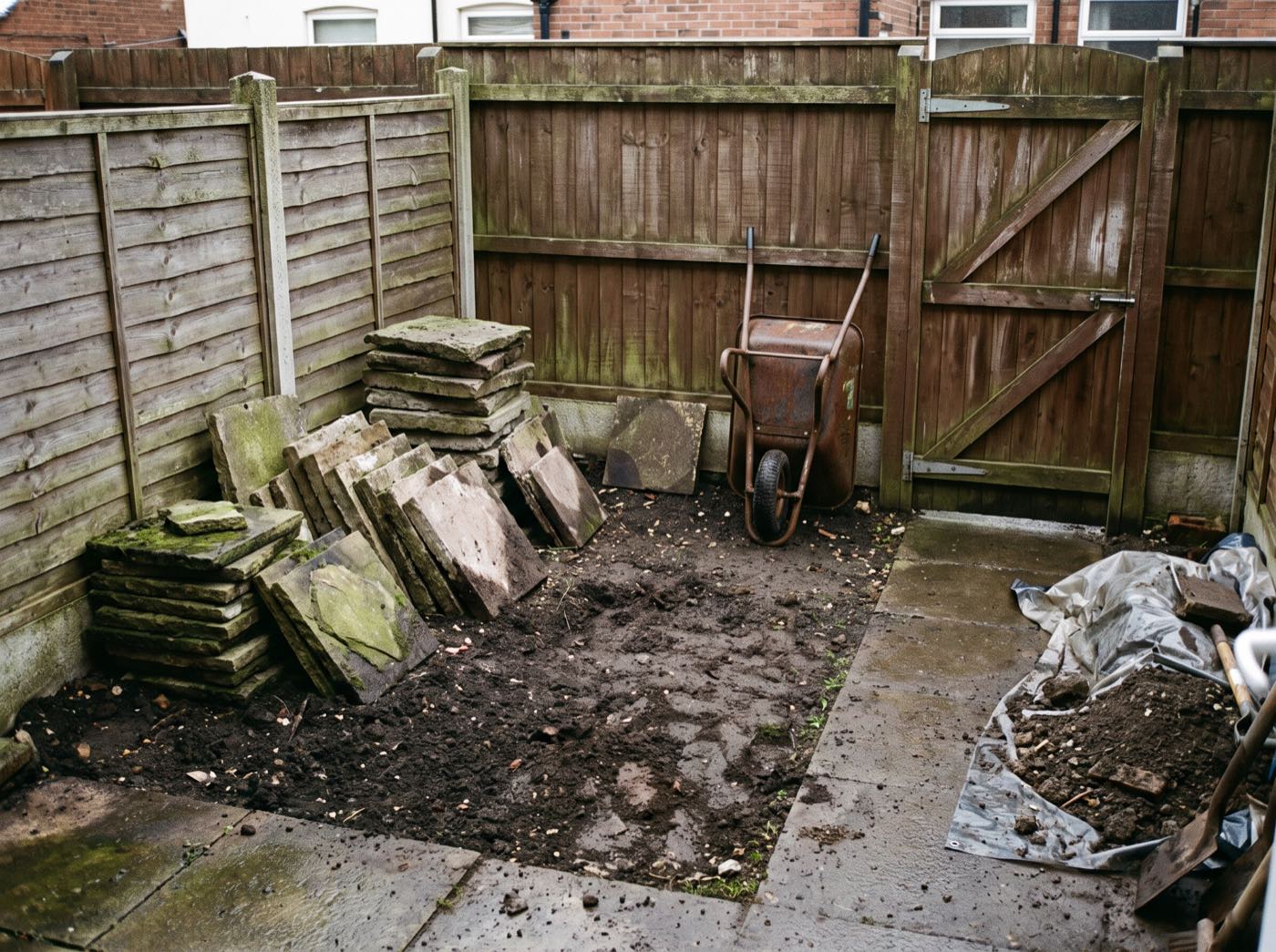
That one detail changes how a renovation is planned. Where there is no side access, everything that comes out — old slabs, broken concrete, spoil from digging down to a firm level — and everything that goes in — hardcore, sand, paving, topsoil, turf — travels the same narrow route.
It is worth knowing before a design is drawn rather than after, because it decides the size of plant that can get on site, the order the work is done in, and where materials can be set down while the job runs.
On the larger plots further out, where there is a drive and a gate wide enough for a machine, none of that applies and the job runs conventionally.
Either way the opening questions are the same: what has to come out, where it goes, what the ground underneath is actually like, and how the finished garden is meant to be used.
Ground, Drainage and Levels Across the Old Coalfield
Wigan grew on the coalfield and the landscape still shows it.
The flashes south of the town centre — the shallow lakes left where old workings settled — are still on the map, and the Leeds–Liverpool Canal threads through the middle of the town past Wigan Pier.
Ground that has been worked, tipped or filled at some point over the last two centuries does not behave like ground that has been left alone.
That matters in a practical way rather than a dramatic one.
Where a lawn sits wet from October to March, or a patio has dropped away from the house, or a path has gone hollow underfoot, the cause is usually below the surface: compacted subsoil, a fall running the wrong way, or a made-up layer that has settled unevenly.
Laying a new surface straight over that repeats the same problem in better materials.
A renovation is the chance to deal with it properly — digging out to something firm, setting falls and a drainage route that take water away from the house, re-levelling where the ground has moved, and only then rebuilding the surface on top.
That is the order the work goes in: what is underneath first, what you can see second.
What a Wigan garden renovation includes
- Removing tired existing surfaces
- Fixing drainage and water pooling
- Re-levelling uneven ground
- Redesigning the layout
- Installing new patios, lawns and features
- A garden that works better and lasts
Where We Work Across the Wigan Borough
We cover Wigan town and the districts around it — Pemberton, Orrell, Winstanley, Worsley Mesnes, Beech Hill, Whelley, Ince-in-Makerfield and Goose Green — along with Hindley and Aspull on the Bolton side, Standish and Shevington to the north, and Ashton-in-Makerfield to the south.
Leigh, Atherton and Westhoughton sit between Wigan and our base in Bolton, Greater Manchester, so the whole corridor is inside the working area.
The borough really is two different jobs in one place: compact plots near the centre where every inch has to work, and generous suburban and semi-rural gardens on the edges with room for a full transformation.
A renovation scales to either — what changes is the amount of groundwork, not the approach.
The city version of the same work is set out on our garden renovations in Manchester page, and the service in full — what a renovation covers and how it is quoted — is on our garden renovations page.
What our garden renovations work in Wigan includes
- Removing tired existing surfaces
- Fixing drainage and water pooling
- Re-levelling uneven ground
- Redesigning the layout
- Installing new patios, lawns and features
- A garden that works better and lasts
How We Work in Wigan
Initial Enquiry
You get in touch by phone, WhatsApp or the website.
Site Visit
We visit your Wigan property, assess the space, and discuss your ideas.
Recommendations
We suggest the best approach for your budget and requirements.
Detailed Quote
You receive a clear breakdown of the work involved.
Installation
The work is carried out with attention to detail from start to finish.
Completion
You’re left with a fully transformed outdoor space.
Trusted Across Greater Manchester
Our Other Services in Wigan
Landscaping in Wigan
Complete garden landscaping — designed, built and finished to a high standard, with …
Learn morePatios & Paving in Wigan
High-quality patios and paving, designed and installed on proper foundations so they stay …
Learn moreDecking in Wigan
Bespoke timber and composite decking — clean, usable outdoor areas built on proper f…
Learn moreFencing in Wigan
Strong, clean, professionally installed fencing for privacy, security and structure &mdash…
Learn moreArtificial Grass in Wigan
Low-maintenance artificial grass that stays clean, green and usable all year — insta…
Learn moreNearby Areas
We cover Wigan town and the districts around it — Pemberton, Orrell, Winstanley, Worsley Mesnes, Beech Hill, Whelley, Ince-in-Makerfield and Goose Green — along with Hindley and Aspull on the Bolton side, Standish and Shevington to the north, and Ashton-in-Makerfield to the south.
Leigh, Atherton and Westhoughton sit between Wigan and our base in Bolton, Greater Manchester, so the whole corridor is inside the working area.
Garden Renovations in Wigan — Your Questions
Our terrace only has rear-entry access. Can a full renovation still be done?
Yes. It changes how the job is sequenced rather than whether it can be done at all.
Everything coming out and everything going in travels the same route, so plant size, the running order of the work and where materials can be set down are all worked out on the site visit before anything is quoted.
The ground has settled and the patio has dropped away from the house. Is that something a renovation fixes?
That is one of the standard reasons for a renovation.
Dropped or hollow surfaces usually mean the base underneath has moved or was never built deep enough, so the fix is to lift the surface, get down to firm ground, rebuild the base with the falls set correctly, and relay on top.
Do you take on the larger semi-rural gardens towards Standish and Aspull, or just town plots?
Both.
The borough runs from small terraced gardens near the centre to large family plots on the edges, and the same renovation process applies to each — the difference is the scale of the groundwork and the amount of material moved.
What happens to the old patio, slabs and spoil once they come out?
Removing tired existing surfaces is part of a renovation, so clearing them is planned in from the start rather than added on.
Get a Free Garden Renovations Quote in Wigan
Thinking about garden renovations for your Wigan garden? Get in touch today for a free, no-obligation quote and honest advice.