
Decking in Wigan
Timber and composite decking for Wigan gardens — built on a frame and foundations that hold the deck level, whatever the ground underneath it is doing.
Get a Fast Response
Tell us a little about your garden and we'll come straight back to you on WhatsApp or by email.
Taking the Fall in the Frame, Not the Boards
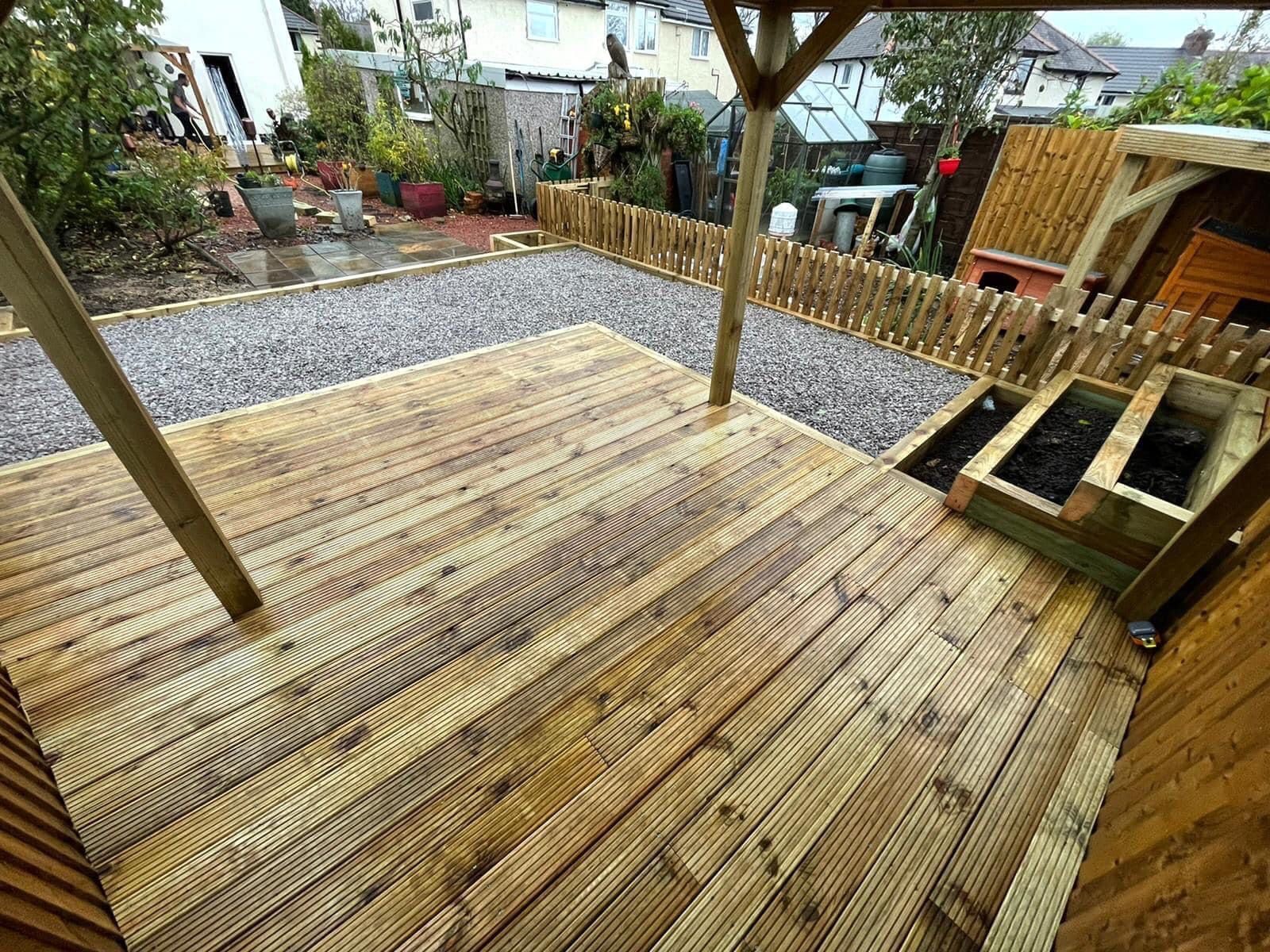
A great many Wigan gardens do not start at the same height as the back door.
On the terraced streets near the centre and out through Whelley, Pemberton and Ince-in-Makerfield, the ground often drops away behind the house, and on the semis further out it can run gently downhill the whole length of the plot. Either way, the deck cannot simply be laid on the ground.
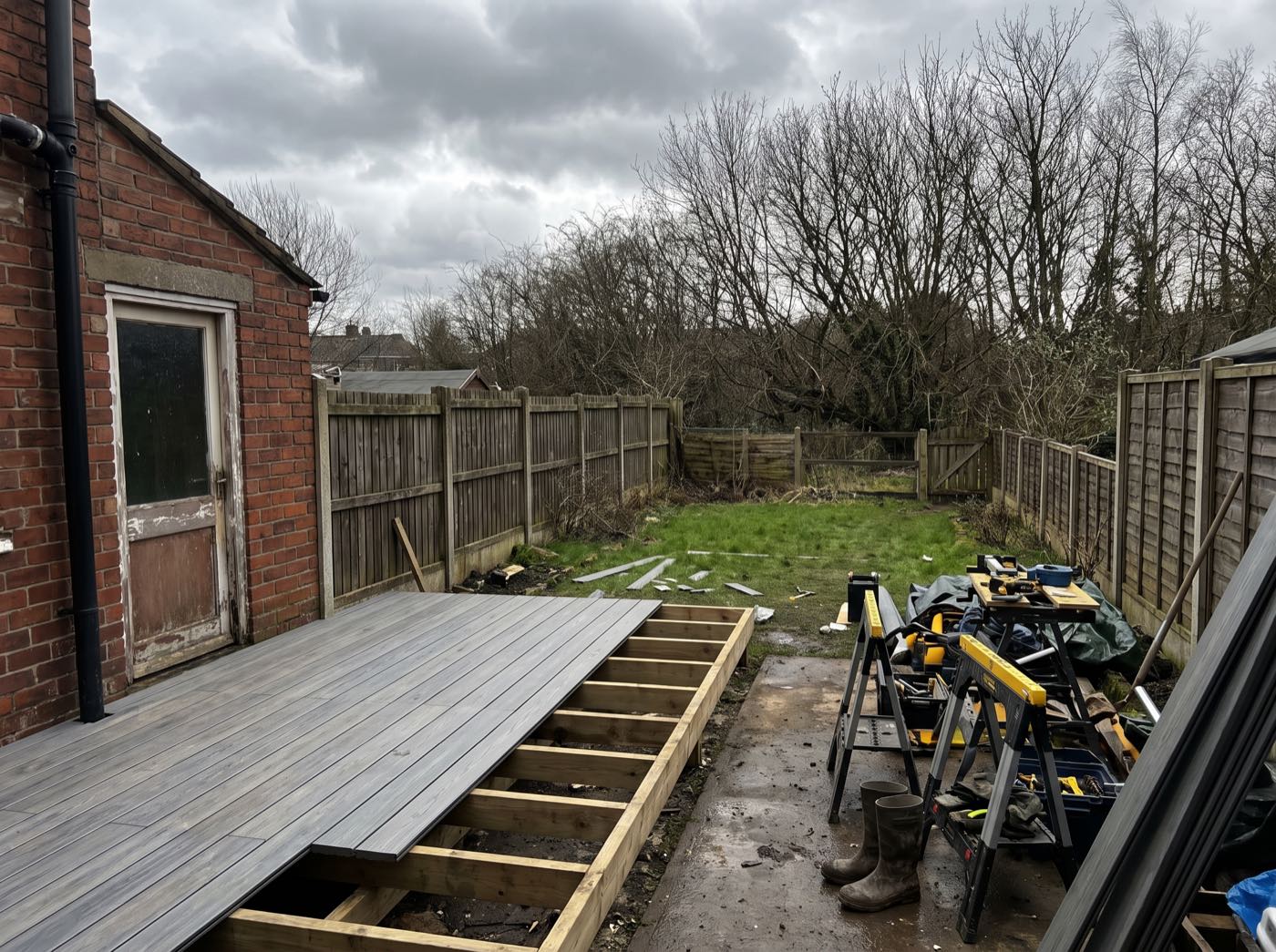
That is what the frame is for. The posts, bearers and joists underneath absorb the fall — set out so the finished surface comes out flat and true, while the ground below carries on doing whatever it was already doing.
Boards are the surface, not the structure, and should never be shimmed into doing that job. On a bigger drop the answer is often a raised deck off the back door with steps down, or two smaller decks at different heights rather than one platform on stilts.
What the frame stands on matters just as much. Where there is soft or made-up ground behind an older Wigan house, the supports need to reach something that will hold — a groundwork question before it is a decking one.
Shade, Damp and Choosing Boards in Wigan
Wigan has more water and more tree cover running through it than people expect.
The Leeds–Liverpool Canal cuts right through the town, the flashes sit to the south, and Haigh Woodland Park closes in the north-eastern edge towards Aspull.
Gardens backing onto any of that — or simply facing north between two rows of terraces — get less sun and stay damp longer after rain.
That should steer the board choice rather than rule decking out.
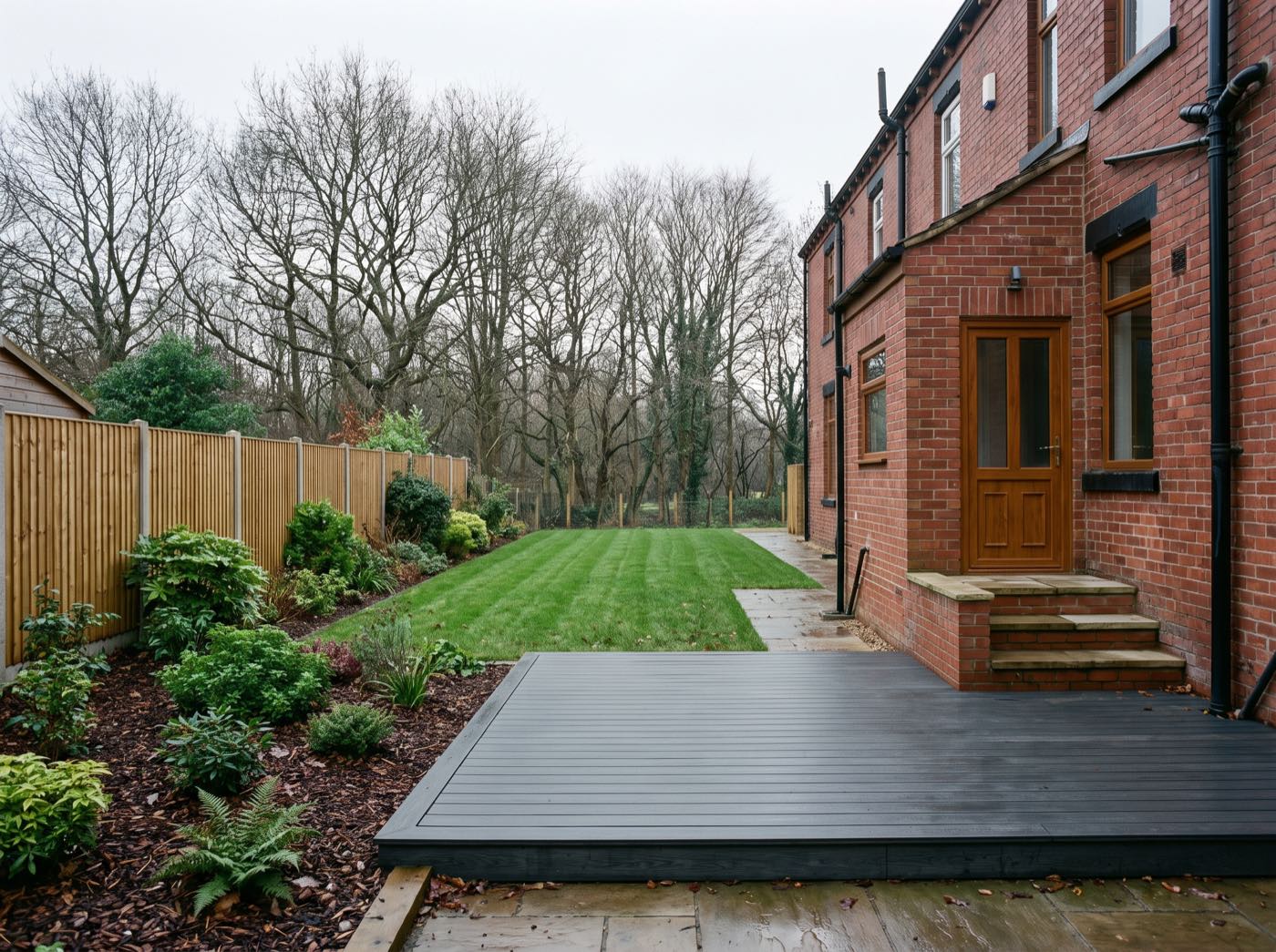
A shaded, slow-drying deck will grow algae given the chance, so grip and cleaning matter more than on an open plot: grooved timber or a textured composite, boards laid so water runs off rather than sits, leaves swept rather than left to mulch into the surface over winter.
Composite costs more up front and needs no treating; timber is cheaper and looks softer, but in a damp corner of a Wigan garden it wants a maintenance routine you will actually keep to. The aspect of your garden is what decides it.
What our decking work in Wigan includes
- Timber and composite boards chosen for the garden’s aspect
- Raised decks where the ground drops away from the house
- Multi-level decks for long, narrow terrace plots
- Frames set out so the fall is taken underneath the surface
- Airflow and drainage kept clear beneath the frame
- Seating and entertaining areas built into the layout
Decking Across Wigan and the Borough
Decking takes us all over the borough rather than just the town.
North of Wigan that means Standish, Shevington, Aspull and Haigh, where the plots are biggest and most often sloping; east and south, Hindley, Ince-in-Makerfield, Platt Bridge, Abram and Leigh; west, Pemberton, Orrell and Ashton-in-Makerfield.
It is a straight run out from our Bolton base along the A58.
The job changes as you move across that area.
In the tight yards behind the town-centre terraces decking is not always the right call at all — where a space is small, hard against a wall and gets almost no sun, paving can be the better surface, and we would rather say so.
Out at Standish, Shevington and Haigh, where plots open up and often slope, there is room for a multi-level deck that steps down the garden and turns a fall into a feature.
If you want the detail on materials, frames and finishes before deciding anything, our decking service page covers it, and the same build is set out for decking in Manchester if you are looking on that side of the county.
What our decking work in Wigan includes
- Timber and composite options
- Raised and multi-level decking
- Level out sloped or uneven gardens
- Dedicated seating and entertaining areas
- Strong structural framework
- Built to last in all weather
How We Work in Wigan
Initial Enquiry
You get in touch by phone, WhatsApp or the website.
Site Visit
We visit your Wigan property, assess the space, and discuss your ideas.
Recommendations
We suggest the best approach for your budget and requirements.
Detailed Quote
You receive a clear breakdown of the work involved.
Installation
The work is carried out with attention to detail from start to finish.
Completion
You’re left with a fully transformed outdoor space.
Trusted Across Greater Manchester
Our Other Services in Wigan
Landscaping in Wigan
Complete garden landscaping — designed, built and finished to a high standard, with …
Learn moreGarden Renovations in Wigan
Full garden transformations for outdoor spaces that are outdated, difficult to use, or sim…
Learn morePatios & Paving in Wigan
High-quality patios and paving, designed and installed on proper foundations so they stay …
Learn moreFencing in Wigan
Strong, clean, professionally installed fencing for privacy, security and structure &mdash…
Learn moreArtificial Grass in Wigan
Low-maintenance artificial grass that stays clean, green and usable all year — insta…
Learn moreNearby Areas
Decking takes us all over the borough rather than just the town.
North of Wigan that means Standish, Shevington, Aspull and Haigh, where the plots are biggest and most often sloping; east and south, Hindley, Ince-in-Makerfield, Platt Bridge, Abram and Leigh; west, Pemberton, Orrell and Ashton-in-Makerfield.
It is a straight run out from our Bolton base along the A58.
Decking in Wigan — Your Questions
How do full-length deck boards get to the back of a terraced house in Wigan?
Access is one of the first things we look at.
Many of the older streets near the town centre have a rear entry between the houses, and boards, joists and bags come in that way.
Where there is no back entry at all, the board lengths and the delivery have to be planned around what will genuinely fit — that gets agreed with you before anything is ordered.
Our garden backs onto trees and stays damp. Does that rule decking out?
No, but it should change the choices.
A shaded garden near the canal or the woodland at Haigh dries slowly, so we would look at a grooved or textured surface for grip, keep plenty of airflow under the frame, and be straight with you about the sweeping and washing a shaded deck needs over winter.
The back door is a couple of steps above the garden. Can the deck start at door level?
That is exactly what a raised frame is for — the deck comes off the house at the height you actually walk out at, and steps take you down into the garden.
How high it can sit, and what it needs underneath to support it, is worked out on site before anything is quoted.
Is decking right for a small terraced yard, or would paving be better?
Honestly, it depends on light and level.
A small yard that is already flat and gets very little sun is often better paved — easier to keep clean and nothing underneath to ventilate.
Decking earns its place where there is a fall to take up, or where you want a warmer surface to sit out on. We will tell you which we think yours is.
Get a Free Decking Quote in Wigan
Thinking about decking for your Wigan garden? Get in touch today for a free, no-obligation quote and honest advice.