
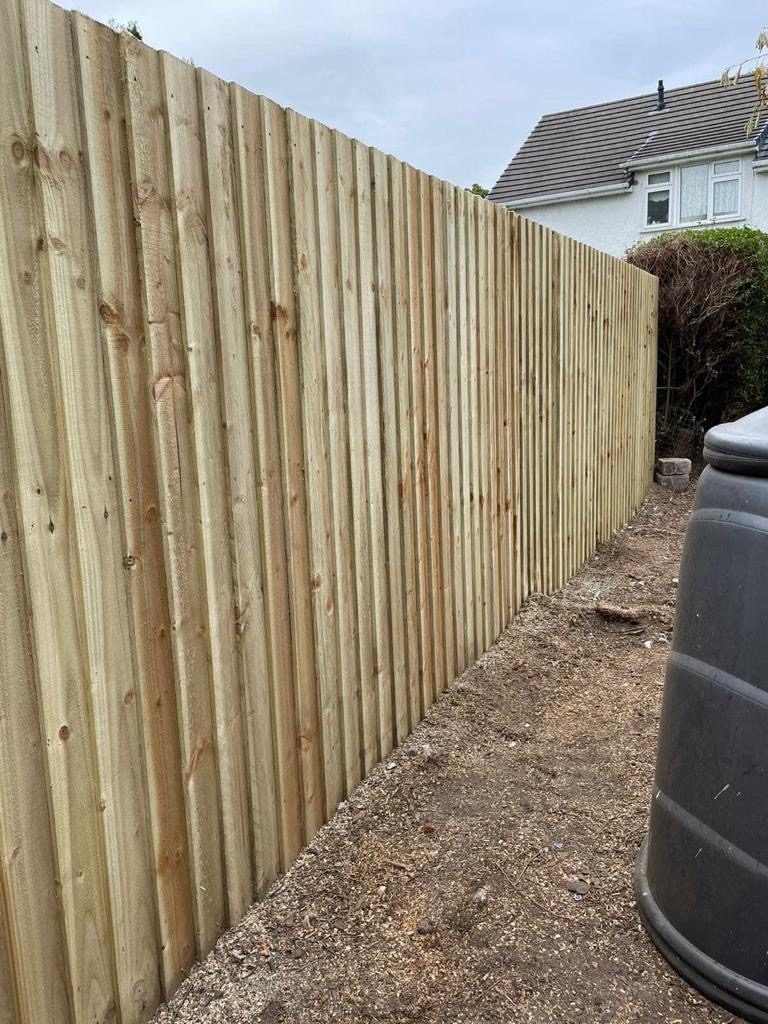
Fencing in Salford
Panel and closeboard fencing across Salford — short runs between terraced yards, posts dug deep and set in concrete, gravel boards fitted. Free, no-obligation quotes.
Get a Fast Response
Tell us a little about your garden and we'll come straight back to you on WhatsApp or by email.
Short Boundary Runs Between Terraced Yards
Much of Pendleton, Broughton and Eccles is Victorian terraces with narrow back plots, so most fencing work here is a short boundary — the width of a yard, one side of a small garden, a return between two houses — rather than the long run people picture when they think about a new fence.
Short does not mean quick. Two panels need their posts down to the same depth as twenty, the line still has to be set out square to the house, and on a tight M5 or M6 plot there is nowhere to stand while you do it.
Spoil has to go somewhere, and every bag of postcrete is carried in by hand.
A few centimetres matter on a run this size: lose the line against a neighbour's wall and you lose the gate opening or the bin space.
Working to Old Walls and Old Post Stumps
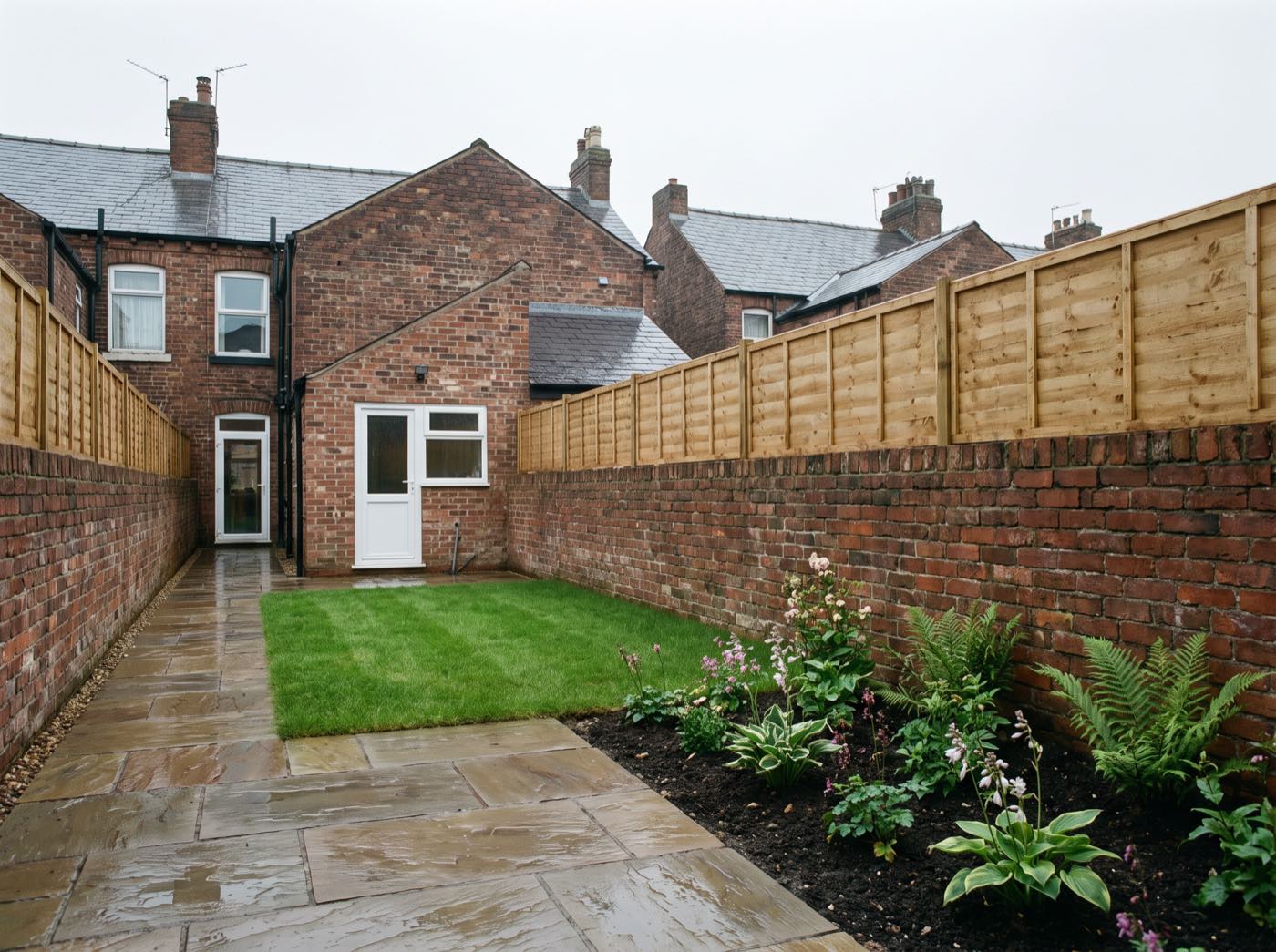
On older Salford plots a boundary is rarely a clean strip of soil.
There is usually a low brick yard wall, a length of it missing, and the footings of the last fence still in the ground.
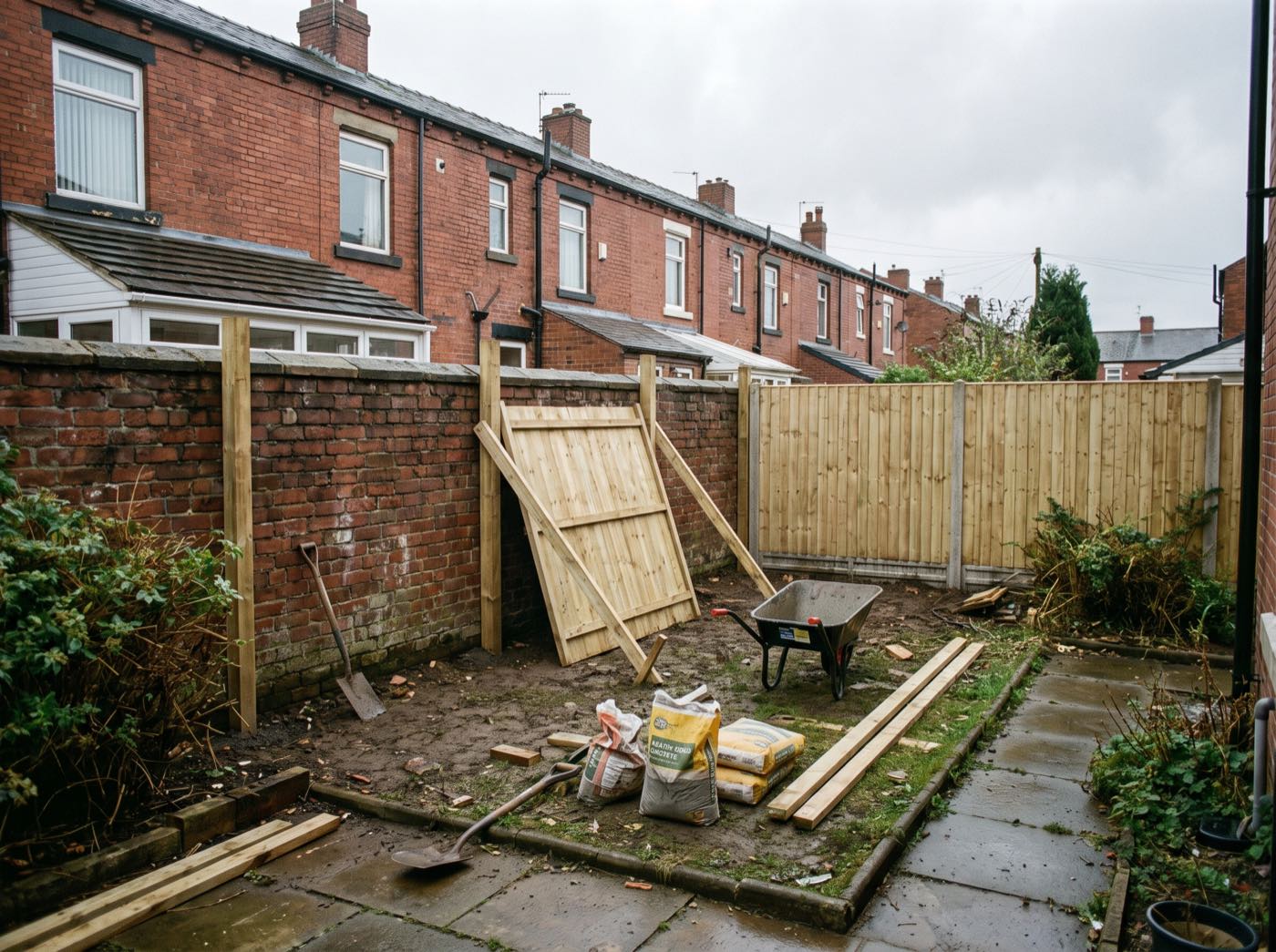
Sometimes the answer is to take the old concrete out and start again in clean ground; sometimes it is to set new posts just inside the wall and leave the brickwork standing.
Nobody can judge a hundred-year-old yard wall from the pavement, so we walk the whole line with you first.
What our fencing work in Salford includes
- Panel and closeboard fencing
- Posts dug deep and set in concrete
- Gravel boards to protect the timber
- Matching gates and access points
- Trellis toppers and feature panels
- Old fence taken away
Open Ground Near the Quays and the Irwell
Away from the terraced streets Salford opens right up.
The water at the Quays, the flat ground either side of the Irwell and the Ship Canal, and the newer plots along them have little standing in front of them, and a fence in that position is a sail more than a screen.
Wind finds a weak post, and it is answered below ground: how deep the holes go, how far apart the posts sit, and whether the timber is kept clear of standing water on a gravel board.
On the most exposed lines it is worth asking whether a solid panel is right at all.
What our fencing work in Salford includes
- Panel and closeboard fencing
- Trellis toppers and feature panels
- Matching gates and access points
- Posts dug deep and set in concrete
- Gravel boards to protect the timber
- Old fence removed and disposed of
How We Work in Salford
Initial Enquiry
You get in touch by phone, WhatsApp or the website.
Site Visit
We visit your Salford property, assess the space, and discuss your ideas.
Recommendations
We suggest the best approach for your budget and requirements.
Detailed Quote
You receive a clear breakdown of the work involved.
Installation
The work is carried out with attention to detail from start to finish.
Completion
You’re left with a fully transformed outdoor space.
Trusted Across Greater Manchester
Our Other Services in Salford
Landscaping in Salford
Complete garden landscaping — designed, built and finished to a high standard, with …
Learn moreGarden Renovations in Salford
Full garden transformations for outdoor spaces that are outdated, difficult to use, or sim…
Learn morePatios & Paving in Salford
High-quality patios and paving, designed and installed on proper foundations so they stay …
Learn moreDecking in Salford
Bespoke timber and composite decking — clean, usable outdoor areas built on proper f…
Learn moreArtificial Grass in Salford
Low-maintenance artificial grass that stays clean, green and usable all year — insta…
Learn moreNearby Areas
Wind finds a weak post, and it is answered below ground: how deep the holes go, how far apart the posts sit, and whether the timber is kept clear of standing water on a gravel board. On the most exposed lines it is worth asking whether a solid panel is right at all.
Fencing in Salford — Your Questions
Our yard in Pendleton is only a few metres across. Is a run that short worth quoting for?
Yes, and short runs are a normal part of the week round here.
The work below ground is the same on two panels as on twenty, so the value is in getting the posts and the line right rather than in the length.
There is already a low brick wall along our boundary. Does it have to come out?
Not always. Posts can often be set just inside a sound wall so the brickwork stays as it is, or the new line can pick up where the wall has failed.
The condition of the wall decides it, and that is a site-visit job.
We are near the Quays and it is very exposed. What stops a fence going over in the wind?
Depth and spacing of the posts, mainly, and keeping the timber up out of wet ground.
On an open plot beside the water we would also talk through whether a solid panel is the right choice, because a boundary the wind can move through takes far less of a beating.
We have a small enclosed courtyard at a townhouse off Chapel Street. What can go round it?
Usually a short screen or panel run rather than a full garden fence, and the questions become access and fixings: whether anything can be dug at all, and what the courtyard floor is built on.
Get a Free Fencing Quote in Salford
Thinking about fencing for your Salford garden? Get in touch today for a free, no-obligation quote and honest advice.